
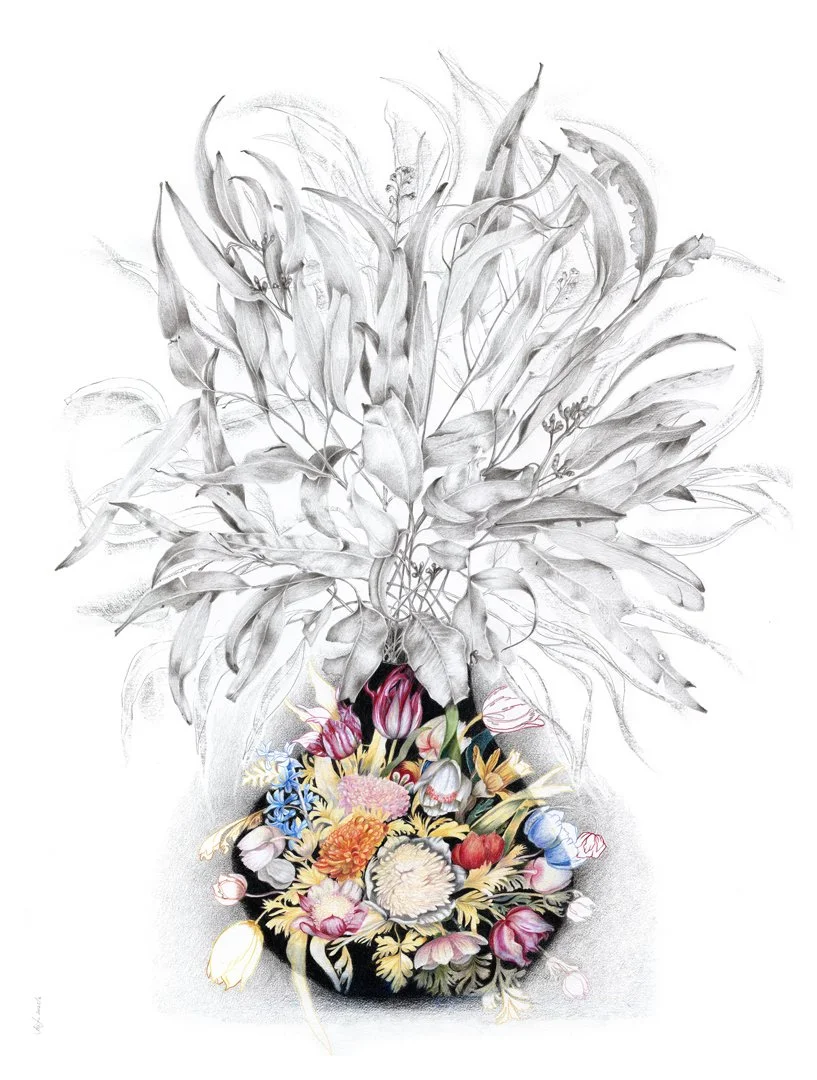
'desire' 2025-2026
'desire' 2025-2026

colour pencil and graphite on Hahnemuhle bright white 300gsm paper, 108 x 80 cm

I have a deep interest across the ages of female artists ... the Antipodes as against the classic European arts ... the desirous (and delirious) nature of flowers/plants in the home, and the fascination with 'still lives'. 

Painting and drawing plant life has been a subject for artists for centuries, classicists to contemporary - indeed, when I studied drawing for the first time I started with plants and my adoration of our natural world only grows over time. Perhaps more so as our biodiversity seems so threatened. I've been doing a series around the anomaly of humans putting flowers/plants in vases inside the house.  Personally I am riddled with anxiety and conflict over this energy and resource hungry activity, never liking to have flowers in my own home, only growing in the wild or a garden. Artists have been depicting vases with flowers, as a subject matter, for centuries, why? 

This particular work's based on an incredible tiny painting I saw in Turin in 2024 at the Museum of Oriental Art @mao_torino by Giovanna Garzoni (1600-1670) a female artist .. rare for that century: 'Vaso cinese con tulipani e altri fiori, due susine e due piselli, c.1641-52' I was completely smitten .. I have redrawn part of her work to form it into a vase, in the same shape as her Chinese vase, as a holder for my own eucalypt leaves, an Aussie gal's favourite leaf.  

Giovanna Garzoni (1600-1670) 'Vaso cinese con tulipani e altri fiori due susine e due piselli' 1641-52

Giovanna Garzoni was a Baroque artist who produced religious, mythological and allegorical paintings in her early days, but she is known for her specialisation in still life. It is possible that she began her apprenticeship under Pietro Gaia, her maternal uncle, who was a painter and engraver in her home town of Ascoli Piceno. Mostly, she is known for the 1620 church commission of a series of Apostles painted for the church of the Ospedale degli Incurabili in Venice, which she contributed to St. Andrew. Garzoni pursued her artistic career with intensity and enjoyed constant success with a life of steady work.
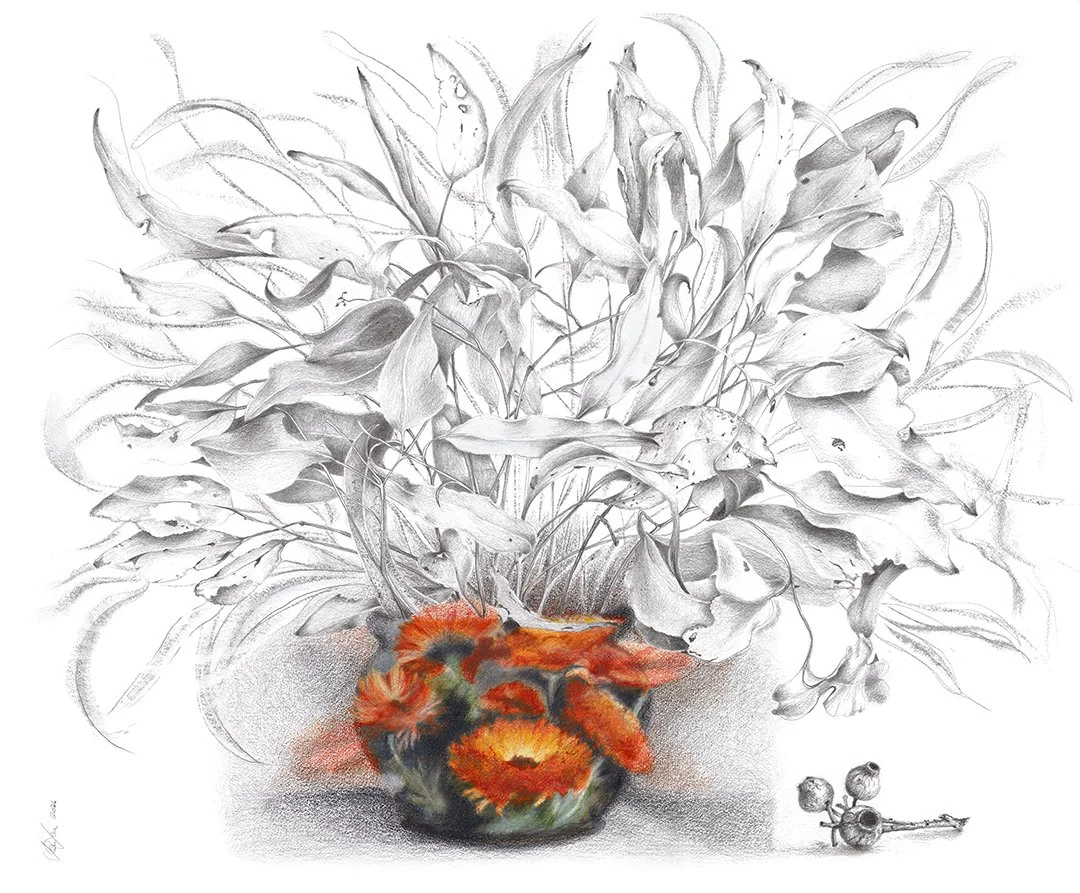
'Thank You CB' 2026
'Thank You CB' 2026

colour pencil and graphite on Hahnemuhle bright white 300gsm paper, 67 x 80 cm

Clarice Beckett 1887–1935, an Australian artist painting subtle, misty landscapes of Melbourne and surrounds, as well as 'still lives' ".... stillness was such a fundamental aspect of her painterly aesthetic." *David Thomas AM (taken from essay accompanying the recent sale of the original painting)

Disregarded by the art establishment during her lifetime, and largely forgotten in the decades after her death, she is now considered one of Australia's greatest artists. Most of her work no longer exists.

This work is to thank her for her unique contribution to art's conversation. This little city in Australia produced this wonderful artist. We all grow from each other.

I have been inspired to incorporate it as a holder for my own eucalypt leaves, another Aussie gal's favourite leaf.
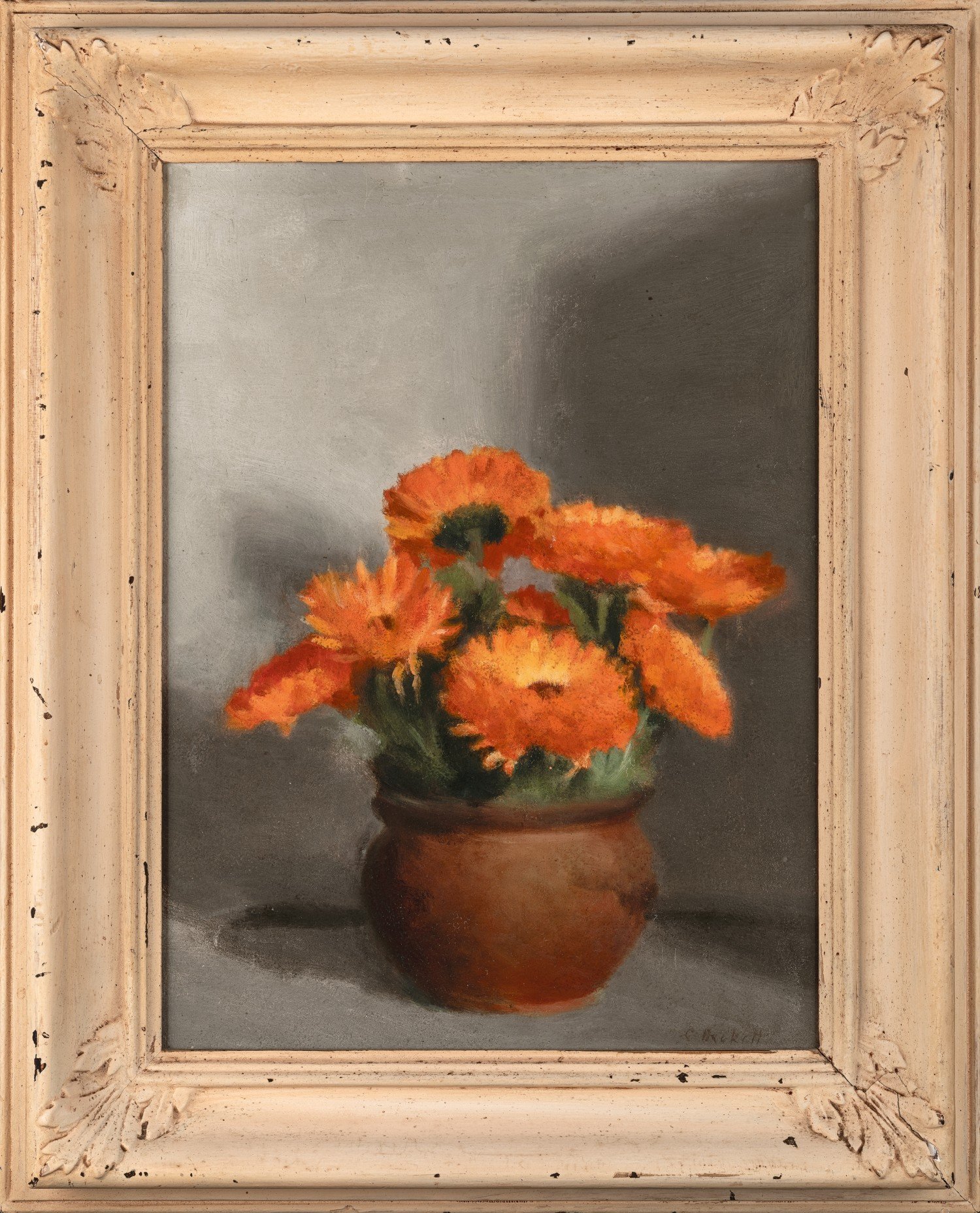
CLARICE BECKETT, MARIGOLDS, c.1925

oil on board, 40.5 x 30.5 cm

While considered valueless in her lifetime 'MARIGOLDS' achieved $92K in 2024 at a Deutscher Hackett art auction.
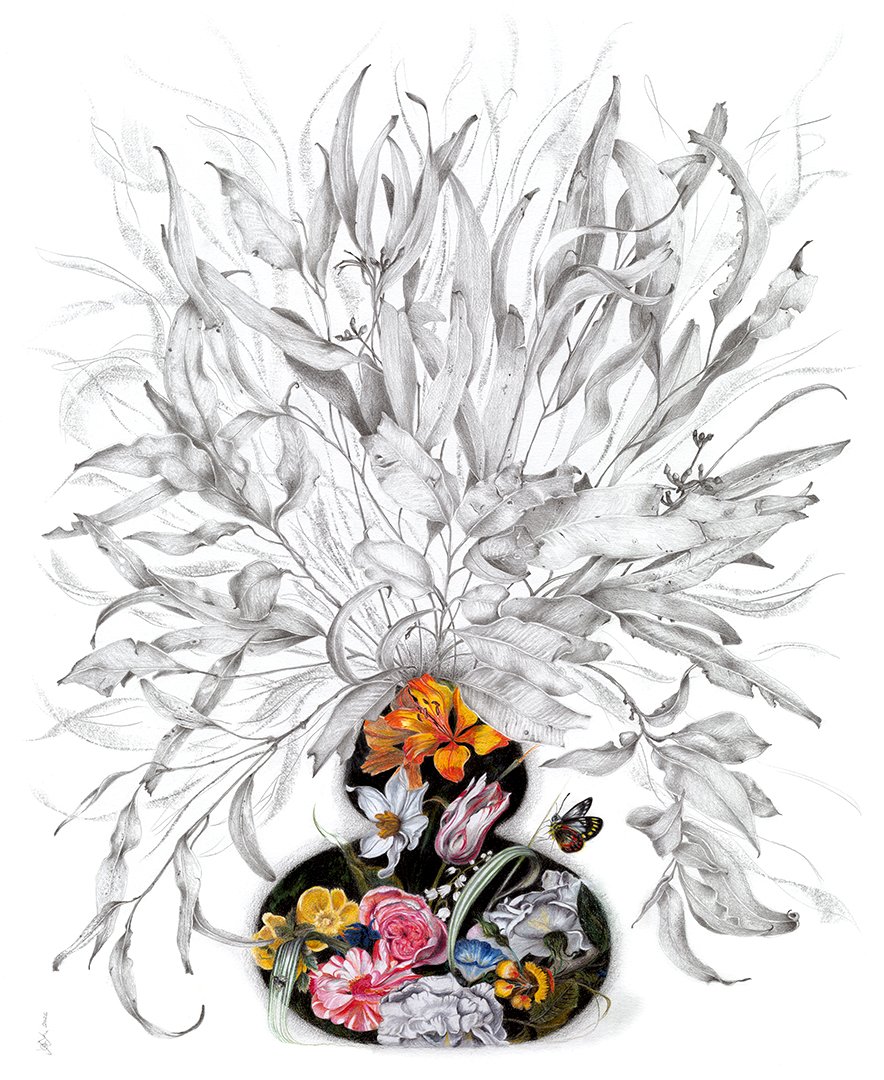
‘butterfly’ 2026
‘butterfly’ 2026

99 x 81 cm
colour pencil and graphite on Hahnemuhle bright white 300gsm paper

My friend pointed this work out in our own National Gallery of Victoria, Maria van Oosterwijck’s “Still life with flowers and butterflies” 1668, my adoration of past female works plus my previous drawings, had inspired her to seek other female ‘still life’ works.

I visited the original and was enthralled. I requested a high-resolution image of it to use as reference for a new work. The painting is so black, black vase, black background (her style) one can hardly tell the shape of the vase that Oosterwijck has included. Manipulating the NGV file, I was able to extract a chroma level to expose its unusual shape.

Here is my interpretation, part of the work “Still life with flowers and butterflies” in the shape of the vase. During her lifetime, Maria van Oosterwijck was internationally celebrated as one of the leading Dutch painters. She devoted herself to meticulous painting. Although Oosterwijck could not become a member of the painters’ guild because of her gender, her work became extremely popular, commanding high prices and awakening the interest of foreign collectors. Her clients included King Louis XIV, Emperor Leopold II and the King of Poland.

While her title is “Still life with flowers and butterflies”, I have only included one butterfly in this interpretative work of mine, the Jezebel as a nod to the work, and to our own Australian butterfly, as well as my arranged gum leaves, joyously celebrating a 21st Century ‘still life’.
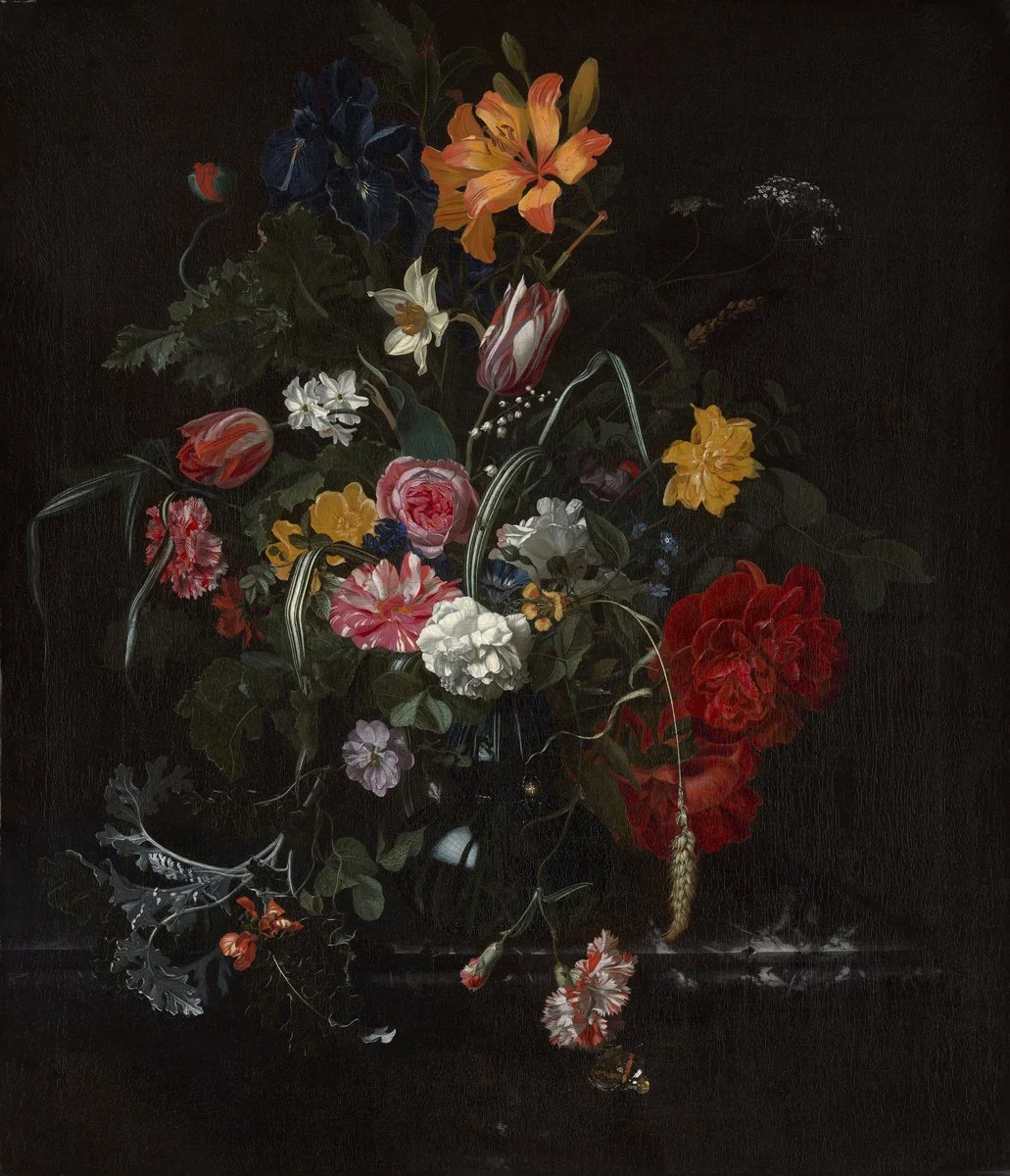
Maria van Oosterwijck, Still life with flowers and butterflies, 1668

During her lifetime, seventeenth century artist Maria van Oosterwyck was internationally celebrated as one of the leading Dutch painters. Today, van Oosterwyck’s paintings remain highly sought after, in part due to the artist’s remarkable attention to detail, as shown in Still life with flowers and butterflies, 1668.

* Maria van Oosterwyck Still life with flowers and butterflies 1668. National Gallery of Victoria, Melbourne. Purchased with funds donated by Dodge Bequest, Margaret Bland, Joy Anderson, Tim Fairfax AC & Gina Fairfax AC, The Betsy & Ollie Polasek Endowment, Michael Heine Family Foundation, Suzanne Kirkham, Carol Sisson, E. & D. Rogowski Foundation, and donors to the 2022 NGV Foundation Annual Dinner and 2022 NGV Annual Appeal, 2024. Image courtesy NGV, Melbourne

Hugest appreciation to NGV for provision of high resolution image to use as reference.

'desire' 2025-2026
Giovanna Garzoni (1600-1670) 'Vaso cinese con tulipani e altri fiori due susine e due piselli' 1641-52
'Thank You CB' 2026
CLARICE BECKETT, MARIGOLDS, c.1925
‘butterfly’ 2026
Maria van Oosterwijck, Still life with flowers and butterflies, 1668
'desire' 2025-2026

colour pencil and graphite on Hahnemuhle bright white 300gsm paper, 108 x 80 cm

I have a deep interest across the ages of female artists ... the Antipodes as against the classic European arts ... the desirous (and delirious) nature of flowers/plants in the home, and the fascination with 'still lives'. 

Painting and drawing plant life has been a subject for artists for centuries, classicists to contemporary - indeed, when I studied drawing for the first time I started with plants and my adoration of our natural world only grows over time. Perhaps more so as our biodiversity seems so threatened. I've been doing a series around the anomaly of humans putting flowers/plants in vases inside the house.  Personally I am riddled with anxiety and conflict over this energy and resource hungry activity, never liking to have flowers in my own home, only growing in the wild or a garden. Artists have been depicting vases with flowers, as a subject matter, for centuries, why? 

This particular work's based on an incredible tiny painting I saw in Turin in 2024 at the Museum of Oriental Art @mao_torino by Giovanna Garzoni (1600-1670) a female artist .. rare for that century: 'Vaso cinese con tulipani e altri fiori, due susine e due piselli, c.1641-52' I was completely smitten .. I have redrawn part of her work to form it into a vase, in the same shape as her Chinese vase, as a holder for my own eucalypt leaves, an Aussie gal's favourite leaf.  

Giovanna Garzoni (1600-1670) 'Vaso cinese con tulipani e altri fiori due susine e due piselli' 1641-52

Giovanna Garzoni was a Baroque artist who produced religious, mythological and allegorical paintings in her early days, but she is known for her specialisation in still life. It is possible that she began her apprenticeship under Pietro Gaia, her maternal uncle, who was a painter and engraver in her home town of Ascoli Piceno. Mostly, she is known for the 1620 church commission of a series of Apostles painted for the church of the Ospedale degli Incurabili in Venice, which she contributed to St. Andrew. Garzoni pursued her artistic career with intensity and enjoyed constant success with a life of steady work.

'Thank You CB' 2026

colour pencil and graphite on Hahnemuhle bright white 300gsm paper, 67 x 80 cm

Clarice Beckett 1887–1935, an Australian artist painting subtle, misty landscapes of Melbourne and surrounds, as well as 'still lives' ".... stillness was such a fundamental aspect of her painterly aesthetic." *David Thomas AM (taken from essay accompanying the recent sale of the original painting)

Disregarded by the art establishment during her lifetime, and largely forgotten in the decades after her death, she is now considered one of Australia's greatest artists. Most of her work no longer exists.

This work is to thank her for her unique contribution to art's conversation. This little city in Australia produced this wonderful artist. We all grow from each other.

I have been inspired to incorporate it as a holder for my own eucalypt leaves, another Aussie gal's favourite leaf.

CLARICE BECKETT, MARIGOLDS, c.1925

oil on board, 40.5 x 30.5 cm

While considered valueless in her lifetime 'MARIGOLDS' achieved $92K in 2024 at a Deutscher Hackett art auction.

‘butterfly’ 2026

99 x 81 cm
colour pencil and graphite on Hahnemuhle bright white 300gsm paper

My friend pointed this work out in our own National Gallery of Victoria, Maria van Oosterwijck’s “Still life with flowers and butterflies” 1668, my adoration of past female works plus my previous drawings, had inspired her to seek other female ‘still life’ works.

I visited the original and was enthralled. I requested a high-resolution image of it to use as reference for a new work. The painting is so black, black vase, black background (her style) one can hardly tell the shape of the vase that Oosterwijck has included. Manipulating the NGV file, I was able to extract a chroma level to expose its unusual shape.

Here is my interpretation, part of the work “Still life with flowers and butterflies” in the shape of the vase. During her lifetime, Maria van Oosterwijck was internationally celebrated as one of the leading Dutch painters. She devoted herself to meticulous painting. Although Oosterwijck could not become a member of the painters’ guild because of her gender, her work became extremely popular, commanding high prices and awakening the interest of foreign collectors. Her clients included King Louis XIV, Emperor Leopold II and the King of Poland.

While her title is “Still life with flowers and butterflies”, I have only included one butterfly in this interpretative work of mine, the Jezebel as a nod to the work, and to our own Australian butterfly, as well as my arranged gum leaves, joyously celebrating a 21st Century ‘still life’.

Maria van Oosterwijck, Still life with flowers and butterflies, 1668

During her lifetime, seventeenth century artist Maria van Oosterwyck was internationally celebrated as one of the leading Dutch painters. Today, van Oosterwyck’s paintings remain highly sought after, in part due to the artist’s remarkable attention to detail, as shown in Still life with flowers and butterflies, 1668.

* Maria van Oosterwyck Still life with flowers and butterflies 1668. National Gallery of Victoria, Melbourne. Purchased with funds donated by Dodge Bequest, Margaret Bland, Joy Anderson, Tim Fairfax AC & Gina Fairfax AC, The Betsy & Ollie Polasek Endowment, Michael Heine Family Foundation, Suzanne Kirkham, Carol Sisson, E. & D. Rogowski Foundation, and donors to the 2022 NGV Foundation Annual Dinner and 2022 NGV Annual Appeal, 2024. Image courtesy NGV, Melbourne

Hugest appreciation to NGV for provision of high resolution image to use as reference.

show thumbnails